Wednesday, November 24, 2010

Adam Elliott


This November has been especially gloomy so my mind has been lingering on brown/gray palettes, and one animated film in particular my mom recommended to me a few months back which fully embraces the color brown; Mary & Max (2009). It's a true claymation film. Everything, including the tiny props and sets, are all handmade with clay plasticine.


It's about a plain Australian girl whose favorite color is brown, with eyes the color of "muddy puddles", and a brown birthmark on her forehead which "looks like poo", who is sad because she has no friends; and a 44 year old, overweight, Jewish, New-Yorker with Asperger's syndrome (voiced by Philip Seymour Hoffman) who also has no friends. Through random chance Mary flips through a New York phone book to find Max's name and decides to write to him.


Max is overwhelmed by the letter he receives and is soon launched into a full-blown panic attack due to the complex and invasive nature of Mary's questions. For a man with Aspergers, any small thing that alters the routine of normal life is cause for great anxiety.


Instead of telling you too much, how about you watch the lovely trailer yourself to get a better idea:


Beware of spoilers; if you want to see this film for yourself please skip the next 5 paragraphs. This is an animation you probably wouldn't watch with a very young child, due to it's black humor and dark themes. It definitely hits it's lowest point when the pregnant adult Mary is standing on a stool with a handful of Valium pills and a noose around her neck because her husband has left her for another man, and her best friend, Max, hates her for the book she wrote about his condition.


Before it is too late Mary receives a forgiveness package from Max just in time, and only because her agoraphobic neighbor is brave enough to face his fears and leave his house.


Max's letter is sweet and heartfelt. He admits that everyone is flawed, and we all must learn to live with our flaws. However, one thing we can choose is whom we befriend. "Hopefully one day our sidewalks will meet, and we can share a can of condensed milk. You are my best friend. You are my only friend. Your American pen-pal, Max Jerry Horowitz".


I was crying in the end when, one year later, Mary finally makes the pilgrimage to New York only to find Max had died that morning. The irony is bitter, but the moment sweetened by the fact that Max's dingy apartment is sprinkled with pieces of her; drawings, photos, cans of sweetened condensed milk, and the crown jewel is the veritable Sistine Chapel of every one of her letters laminated and plastered to the ceiling. She was everything good and meaningful to him, and he to her.


Despite the fact that they had the deepest of friendships, theirs was never meant to be consummated in a face to face union. But, perhaps it is better that way. We can be rest-assured that Mary will continue forward in strength, now that she has a little one to care for, and she will always hold her memories of Max close to heart.


Before seeing Mary & Max I had never heard of the Melbourne-based, director Adam Elliot before, but collectively his five claymation films, (including Uncle (1996), Cousin (1998), and Brother (1999)) have participated in over 600 film festivals and received over 100 awards, including an Oscar for his short film, Harvie Krumpet (2003), narrated by Geoffery Rush, which you may enjoy here (Part 1):


Elliot is a very gifted writer and storyteller, whether he's telling personal stories, funny stories, or moving stories, all follow the lives of average, quirky folk. He focuses on relaying their sparse moments of joy, but more often, the unpleasant moments they experience in their short lives.


Life is indifferent and can be ironically cruel at times, and death is just as abrupt. Most of the characters aren't even aware of their misfortune because it has become a natural part of their everyday lives, such as living with insane parents, or a mental or physical disability. Elliot often leaves the audience feeling uneasy.


His characters still find joy, however, in a variety of simple pleasures; a loving pet, a can of condensed milk, a warm seat in the sunlight, and most of all, talking with a dear friend.


Please enjoy one final clip from Adam Elliot's early short, Cousin:


I find there is more depth and poignancy in five minutes of an Elliot animation than in most 2 1/2 hour films. I know that in the last six months I have been more moved watching animated films than live-action ones. Isn't it interesting how animation can be so moving despite the fact it is told with "inanimate" objects? Well, the inanimate becomes animate through the skillful hands of the animator. That's why it's magic.


That's also why I prefer stop-motion to computer animation. Computer animation often comes off as sterile, rigid, and hollow feeling. True, the quality is incredible, and they're getting great at making if feel alive, but it takes a lot to force a computer out of it's need for geometric precision. Stop-motion involves the hands of a living, breathing human, and with that comes all the flaws and imperfections of human touch, but that's also what gives it love and character.


Elliot's entertaining stories about friendship and heartache remind us to appreciate the simple joys in life. He is truly a gifted filmmaker and I hope we may see many more talented animators like him emerge from Australia in the near future.

~S

Tuesday, November 16, 2010

Koldo Barroso


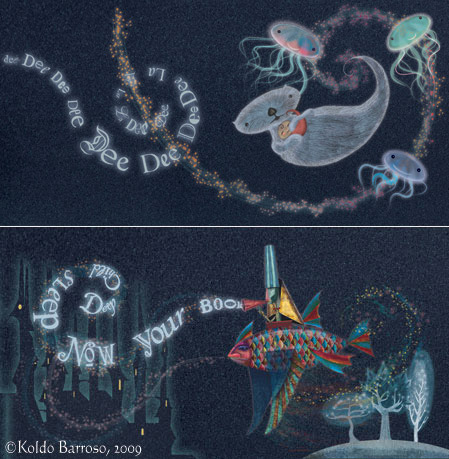
I'm in a fanciful mood today, so I wanted to post on an artist I found online awhile back whose distorted creations and moody palettes are quite whimsical indeed; Koldo Barroso.


He's originally from Madrid, but his family is from the Basque country of Northern Spain (where I lived for a year and a half!). Currently he lives in Bellingham, Washington with his wife, Naomi, illustrating goblins and other fairytale creatures in his fantasy books and graphic novels. Check out his website and blog at: Making Visible an Invisible World of Magic, Mystery, and Imagination http://www.koldobarroso.com/


He just recently published a book entitled, Kooky Pets which I desperately want to read and own one day. The illustrations alone hint at the magical stories contained within. *Note, all illustrations are property of Koldo Barroso.*


Here are some samples of CD album sleeve covers he's illustrated. I love his use of silhouettes and delicate flourishes. Apparently he is an amateur musician and composer as well. It would be interesting to hear some of his samples; I wonder if they sound the way his art looks?


Koldo also creates lively character sketches with creative little stories that accompany each one.


Wonkee Di Wonkee

He was standing alone at the front door of the Girardi’s house, sleeping inside a little basket with a little handwritten tag that said: “Wonkee Di Wonkee“. And he was the cutest baby they had ever seen. The Girardi family, who had no children nor pets, were very glad to adopt him, despite the fact that they didn’t know the origin of this adorable mysterious creature. They didn’t know what kind of pet he was, they didn’t know how to pamper him, and they didn’t know how to feed him!


The Homesick Willow

This is the story of an English poet who became bored of his monotonous life and his comfortable little world. So he dreamed of running away, become a sailor and sailing the four corners of the world. And he dreamed he was a Pharaoh and knew the secrets of ancient Egypt. And he wondered how it would be to be a lark and fly far away in the summers. And then , one day while having a walk in the woods, he wished he was a tall willow tree. But what he didn’t notice is that when making his wish he was standing inside of a magic fairy circle of mushrooms. And everyone knows that when you make a wish inside of a magic fairy circle your wishes come true! So he truly became a tall willow tree.

His artistic inspiration comes from hundreds of different sources throughout the world, including a few of my personal favorites: Arthur Rackham, Jim Henson, and Edmund Dulac.


There's also something about his illustrations that remind me of the illustrations of Lane Smith (illustrator of The Stinky Cheese Man and James and the Giant Peach); however Koldo's techniques are much more refined and serpentine in line and style than Smith's.


In short, Koldo Barroso's illustrations convey the artistry, wonder, and whimsy inherent in all great fairytale books. I'm excited to see how his future projects unfold and where his wild imagination will lead us next!

~S

Sunday, October 31, 2010

The Brothers Quay


Now that Halloween is finally here, I wanted to post on a talented duo of animators with a dark and disturbing sensibility befitting the season. Many have heard of the Brother's Quay, or at least seen their unsettling and experimental animations, however, it's their blend of innovation, surrealism, and substance that has earned them a place in the annals of film history.


I don't quite remember the first time I was exposed to a Quay film (not to be confused with Adam Jones' copycat-style Tool music videos); it was in high school at some point during my "dark" period when I was into goth/punk rock and Giger art. I remember being blown away by their originality and wondering at what it could possibly mean.


Identical twins, Stephen and Timothy Quay, were born in Pennsylvania, 1947, and would jointly follow the same path their whole lives. They studied illustration in Philadelphia before going on to the Royal College of Art in London where they started to make animated shorts in the 1970s. They have lived in London ever since, making their films under Koninck Studios.


They are greatly influenced by Eastern European animators, most notably Jan Svankmajer, for whom they made two homage documentaries, The Cabinet of Jan Svankmajer, and Punch and Judy. You'll often see Svankmajer's characteristic raw meat tongues in their films.

They have a great passion for detail, texture, lighting, and the use of wild focus and camera movements to more fully integrate the audience in the viewing experience.


Over their 30 year career the brothers have made roughly 22 films, 4 of which are documentaries, another 5 are music videos (including a chicken and fruit sequence for Peter Gabriel's video, Sledge Hammer, directed by Nick Park), a few commissioned idents, and some live action features, but all featuring their highly stylized animation. They've also designed stage sets for several operas and plays.

They are probably most well known for their classic 1986 film Street of Crocodiles, which filmmaker Terry Gilliam selected as one of the ten best animated films of all time.


Those favoring a plot driven narrative will need to look elsewhere than a musically and visually provocative Quay film. When constructing a new film the brothers with often begin with a premise or a puppet, but once they begin constructing the sets and decor, the script often goes "out the window" as they say, and everything begins anew, evolving very organically.


Just as with Simonova's sand animations, music is crucial to the Quay's films; they refer to it as "the blood" of the film, which creates a dialogue with it's own language. Just as a choreographer must internalize the music to invent new movements, so must the Quay brothers listen to it until it's in their "veins". I love how they talk. You should really watch an interview with them, they are the flesh and bone embodiments of their films.


Basically you can watch a Quay film in one of two ways: focusing intently in order to take away some semblance of meaning, or with little to no focus to simply absorb the mise-en-scéne. I'll often do the latter first, to sense my initial reaction, and then the former to grasp any underlying message. Often times the film cannot be fully understood without the literary basis taken into account, but more often than not, I think the brothers would prefer we free our minds to accept the impressions the work imparts on us, rather than worrying about the ultimate meaning of the imagery.


That's what I've chosen to do with a few of my favorite Quay animations I will here dissect. Please enjoy the clips; you will undoubtedly take away something very different than I do, so please feel free to share your thoughts in the comment section if you like.


Stille Nacht (Silent Night, 1988), MTV Ident,
1 minute 46 seconds


Classic Quay. And commissioned by MTV no doubt... back when MTV was cool anyway. The animation is breathtaking in it's fluidity and organic nature, isn't it? Something outside is magnetizing everything around it with alarming rapidity. It grows and breaths like a living creature. The doll finds a spoon which begins to attract the same powerful force into it's abode. Will it soon be overtaken as well? Either that, or it's about a person with schizophrenia.


It kind of reminds me of that X-Files episode where Mulder and Scully are stranded in a forest when darkness falls, and a mutated species of green-glowing, flesh-eating arachnids swarms them and wraps them in a cacoon.


The Calligrapher (1991), BBC2 Channel Ident (Rejected), 1 minute


Even though this is one of their more "commercial" commissions, it is stunningly beautiful. So intriquite and elegant in detail, and they actually use the color turquoise, a rarity in Quay films. The Calligrapher is an eloquent 18th-century writer and artist. Like all artists he needs a quill to write down his flourishing ideas. The many hands represent the many directions and tangents to which his ideas expound.


In turn, his ideas become images of wings that set him free. He finally returns the quill to the plumes in his hat, perhaps representing the cycle of ideas from the brain to the paper and back to the brain. In the end, another idea is twitching to come forth.


Are We Still Married (1992), music video for His Name is Alive,
3 minutes and 19 seconds


On one side of a heart-shaped ping-pong paddle are crying eyes, and the other a heart. The paddle is held by a woman being portrayed as a girl to best represent her current emotional state. The girl beats a ball around; a metaphor for the "game" of love and hate in relationships. Her heart becomes thorny, her fingers too become thorny (meaning her emotional and physical senses are on the defensive).


A man beats on the door, probably her husband. To escape her mental anguish the girl repetitively heaves up and down on her tip-toes, trying perhaps to fly away? Witness to all the fluster is a bunny, symbolic of an innocent pet, stuffed animal, or even child; whatever it may be it is equally as trapped and must console the girl. In the end a tear returns to the eyes which close in resolution; maybe the girl has found solace in some decision...


Frida (2002), short animated dream sequence, 1 mintue 12 seconds


This dream sequence takes place right after Frida Khalo's crippling car accident in which metal bars punctured her legs and torso, fracturing her pelvis and destroying her reproductive system. During the sequence she is unconscious but imagines the hospital staff as skeletons in a very dia de los muertos Mexican fashion. The sequence looks very Tim Burtonesque, but also like something done by René Castillo. :) Did you notice Svankmajer's meat tongues? This accident would play a major role in developing future surrealist imagery in Khalo's paintings.

The Unnamable Little Broom (1985), loosely based off the Epic of Gilgamesh, 10 minutes and 43 seconds


A territorial, circus-like creature has set croquet hoops and wire trappings all throughout his box. I'm not sure what the melting ice cube or dandelion represent, but they look pretty gnarly. After he leaves, an awesome looking winged-creature appears. The Brothers Quay should seriously work with feathers more often, they craft them beautifully.


On a table top is a pretty obvious painting of a woman (which looks like something painted by Giger), and provides the creature with a private peep show of a swinging piece of meat. In the drawer where the cricket resides, the meat appears (looking a lot like a vagina), and basically the winged-creature is enveloped in his desires while simultaneously being trapped by the circus creature.


I'm not sure why the circus creature throws his cricket away, maybe it's because he felt the cricket betrayed him by luring the winged-creature there? Either way, the winged-creature is now captured, his wings clipped, and is forever the circus creature's prisoner. I especially like the director's use of form and shadow in this film.


Rehearsals for Extinct Anatomies (1988)


This is probably one of the Quay's most visually striking and melancholy films. Every camera angle, change of focus, and action is unique and pulls you in. The black stripes and strings enveloping the white walls are especially impressive. The wirey creature rubbing his boil is grotesque, and his obsessive actions seem to charge the rest of the space with an equal amount of tension, causing wires to fill all the rooms.


The image of a barcode is often used, maybe suggesting how society processes it's citizens, or how businesses process their customers, or maybe how hospitals process their patients? I say hospitals because there's something institutional feeling about the stark white rooms with tables in them. And the couple in the dark, central room looks ill, one man lying in a bed, and the other performing the same repetitive rubbing as the wire creature (almost as if the wire creature is controlling him, or reflecting his pain?). The camera moving in and out gives the feeling that they are being monitored, maybe by a hospital staff, and the scribbling hands could represent what is being documented.


To be perfectly honest I don't like the feeling of this film, but I wanted to share it mostly for the stunning visual effects it features. Often times Quay films remind me of that movie in The Ring; watch it and seven days later you'll die.

True, Quay films are not the most pleasant things to watch, but they do address complex issues related to the human condition in revolutionary ways. Basically my motto for Quay films is: "Too much Quay a day makes everything gray, but a Quay here and there makes you think, makes you dare".


The 70's and 80's were a time when experimental animation abounded; nowadays it seems we see less and less support for such independent endeavors. Hopefully the value for such art will continue to be appreciated as our world of entertainment becomes increasingly glitzy and hollow in content.

I will leave you with a quote from the ingenious duo-directors:

What happens in the shadow, in the grey regions, also interests us – all that is elusive and fugitive, all that can be said in those beautiful half tones, or in whispers, in deep shade.

– The Brothers Quay
~S